
数字治理嵌入能够带来治理效能的提升吗?
大数据、云计算、人工智能的飞速发展为政府效能提升提供了绝佳的契机。数字治理所蕴藏的巨大红利,使得地方政府正处于“技术憧憬期”。地方政府正热切地将数字治理嵌入到各种治理场景中,并将其作为解决诸多问题的通用手段。然而,数字治理果真能为地方政府的治理效能带来立竿见影的改善吗?近日,管理学院青年研究员关斌及其指导的硕士研究生喻耀恩发表在公共管理国际顶级刊物Governance上的研究为这一问题提供了新的理论解释。
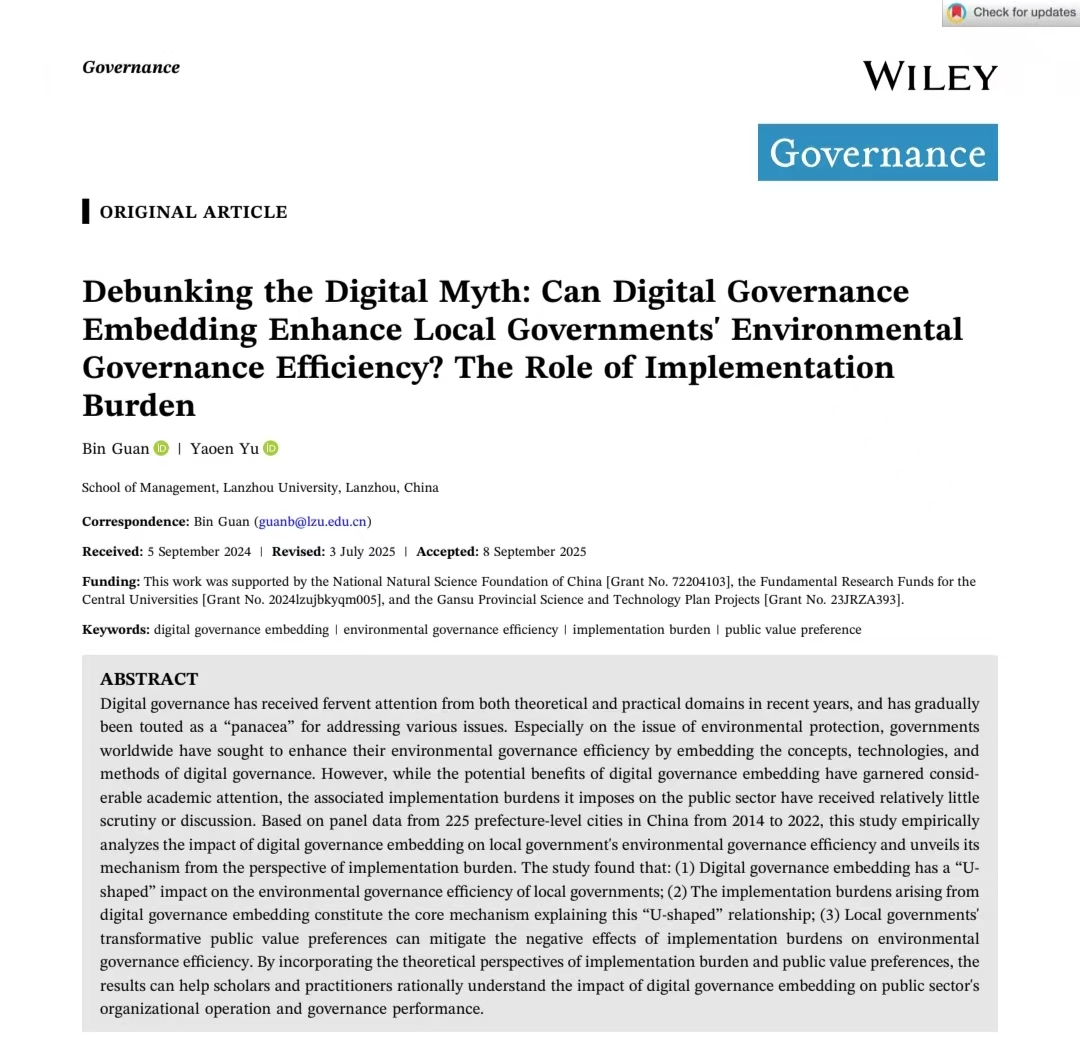
论文发表截图
01 数字治理嵌入的双刃剑效应
在数字治理嵌入的初级阶段,其消极影响可以掩盖掉数字治理的积极作用。这是因为政府的数字化转型本质上是一个涉及组织变革、技术融合与制度创新的复合型进程,其治理效能的释放往往存在时滞效应。尤其是在管理架构尚不成熟时,即便前期投入大量组织资源,也往往难以取得显著的成效。甚至有可能在短期内引发组织内部的冲突和紧张局势,并产生适得其反的效果。这一研究发现挑战了传统的关于数字治理嵌入与治理绩效改善间的线性认知。
02 如何理解实施负担在数字治理嵌入过程中的作用?
数字治理嵌入过程中,地方政府面临着一系列新增的规则和要求,比如人员培训、流程变革和风险规范等。对于这些新增规则的遵从和执行,不可避免地给行政机构带来了新的实施负担。在预算紧缩和机构精简的背景下,短时间内对于激增的政策、规则和要求的实施,非常容易让行政机构疲惫不堪,从而导致机构的内生功能障碍。加之,实施负担会加剧地方政府在资金和注意力分配上的失衡,并减少地方政府能够投入到环境治理核心业务上的时间、精力和资源。
03 地方政府的公共价值偏好会发挥什么影响?
地方政府的变革型公共价值偏好能够有效缓解实施负担的负面影响。这是因为政府所偏好的公共价值对其行为逻辑具有至关重要的影响。在变革型公共价值偏好的影响下,地方政府往往对自我变革持更为开放的态度,并展现出更强的适应能力,从而缓解实施负担对环境治理效率的负面影响。
04结语
该研究突破了单纯强调数字治理技术优势的传统视角,通过将实施负担与公共价值偏好纳入分析框架,为理解数字治理在公共部门的复杂效应提供了新的理论解释。研究成果对于公共部门理性规划数字治理嵌入时机、优化资源配置、培育适应性治理能力提供了启示。
近年来,管理学院不断强化“有组织的科研”,持续完善科研成果评价与激励机制,有效激发了人才创新活力。在科研体制机制持续优化的支撑下,管理学院在高水平科研成果上不断取得新突破,为学院高质量发展筑牢了基础。
期刊介绍:
Governance由Wiley和国际政治科学协会(IPSA)政府结构与组织研究委员会(SOG)联合出版,是AJG(ABS)四星级期刊,也是公共管理学科公认的5本顶级期刊之一。长期以来,Governance以审稿严苛、发表难度大著称。其一年出版4期,年发文量50余篇,接受率仅8%。
作者简介:

关斌,博士,兰州大学管理学院青年研究员,硕士研究生导师。研究方向为政府绩效治理、环境治理、公共价值理论与方法。主持国家自然科学基金青年项目和国家社科基金优秀博士论文出版项目各一项。研究成果主要发表于Governance、Public Management Review、Administration & Society、《公共管理学报》、《中国行政管理》等权威期刊上。

喻耀恩,兰州大学管理学院2025级硕士研究生。研究方向为数字治理理论与方法、政府环境治理等。
附论文摘要:
Digital governance has received fervent attention from both theoretical and practical domains in recent years, and has gradually been touted as a “panacea” for addressing various issues. Especially on the issue of environmental protection, governments worldwide have sought to enhance their environmental governance efficiency by embedding the concepts, technologies, and methods of digital governance. However, while the potential benefits of digital governance embedding have garnered considerable academic attention, the associated implementation burdens it imposes on the public sector have received relatively little scrutiny or discussion. Based on panel data from 225 prefecture-level cities in China from 2014 to 2022, this study empirically analyzes the impact of digital governance embedding on local government's environmental governance efficiency and unveils its mechanism from the perspective of implementation burden. The study found that: (1) Digital governance embedding has a “U-shaped” impact on the environmental governance efficiency of local governments; (2) The implementation burdens arising from digital governance embedding constitute the core mechanism explaining this “U-shaped” relationship; (3) Local governments' transformative public value preferences can mitigate the negative effects of implementation burdens on environmental governance efficiency. By incorporating the theoretical perspectives of implementation burden and public value preferences, the results can help scholars and practitioners rationally understand the impact of digital governance embedding on public sector's organizational operation and governance performance.
文章链接:
Guan, B., & Yu, Y. (2025). Debunking the Digital Myth: Can Digital Governance Embedding Enhance Local Governments’ Environmental Governance Efficiency? The Role of Implementation Burden. Governance, 38(4), e70063.
